


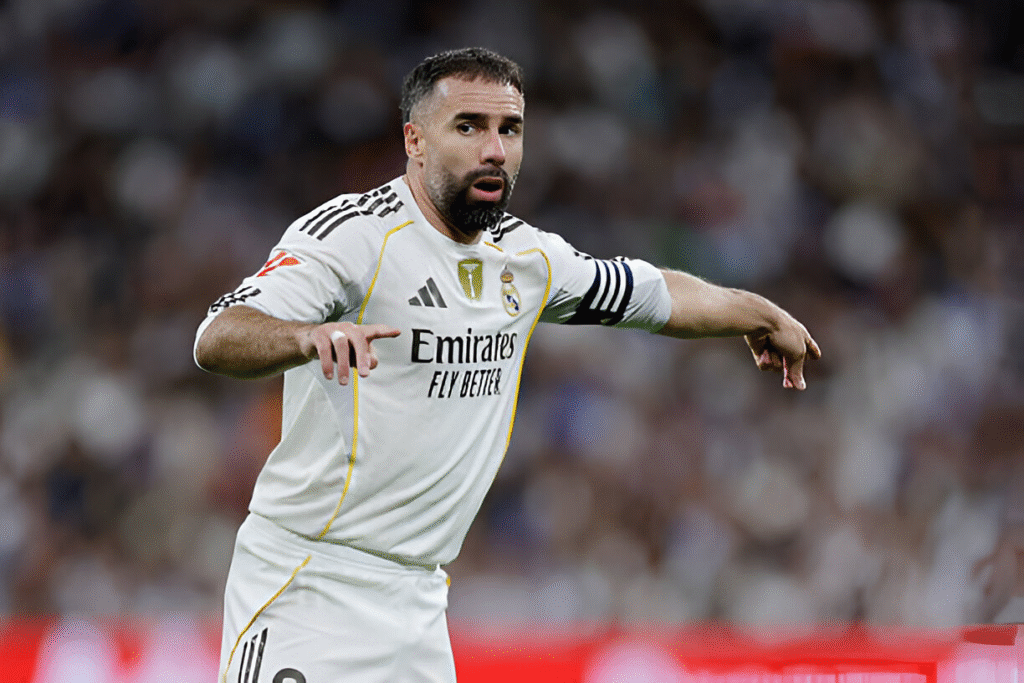
Following tests carried out by the Real Madrid Medical Services, club captain Dani Carvajal has been diagnosed with the presence of a loose body in his right knee joint. He will now undergo an arthroscopy.
Key points
- Diagnosis: loose body inside the right knee joint.
- Next step: arthroscopic procedure (minimally invasive surgery).
- No official return date provided at this stage.
- Further updates will follow once the procedure and post‑operative evaluation are completed.
What the diagnosis means
A “loose body” is a small fragment of cartilage or bone that has detached and is moving within the knee joint space. In match situations, such a fragment can intermittently interfere with smooth movement, leading to sharp pain, swelling, a reduced range of motion, or even a sensation that the knee locks or “catches”. For a high‑intensity full‑back whose game relies on repeated accelerations and changes of direction, these symptoms can be particularly limiting and unpredictable.
The club’s decision for Carvajal to undergo arthroscopy is consistent with best practice for addressing mechanical symptoms caused by an intra‑articular loose fragment. The aim is to relieve symptoms, protect the joint surfaces, and allow a progressive return to full football activity once post‑operative healing is underway.
Arthroscopy explained
Arthroscopy is a minimally invasive surgical technique performed through very small incisions. Surgeons insert a camera (arthroscope) to visualise the inside of the knee and use specialised instruments to remove the loose body and address any additional irritation they might find, such as frayed cartilage or synovial inflammation. Because the procedure is performed through small portals rather than a large open incision, it generally allows for faster early recovery milestones.
Post‑surgery, players typically follow a tailored rehabilitation plan overseen by medical and performance staff. Early goals focus on managing swelling and restoring range of motion; subsequent phases introduce progressive strength work, neuromuscular control, and on‑pitch reconditioning. Exact timelines can vary based on intra‑operative findings and individual response to rehab, which is why the club has not committed to a specific return date at this stage.
Recovery and return‑to‑play
While every case is unique, the broad pathway after knee arthroscopy moves from controlled loading in the gym to straight‑line running, to change‑of‑direction drills, and finally to full team training before competitive selection. The staff will track objective criteria—pain levels, swelling, strength symmetry, stability, and functional tests—rather than the calendar alone. RMxtra will respect the official guidance and report milestones as the club releases them, such as confirmation of a successful procedure, reintroduction to group training, and eventual medical discharge.
What it means for the squad
As captain, Carvajal’s influence extends beyond his defensive work: he sets the tone for intensity, communication, and tactical discipline. In the short term, Real Madrid are expected to balance minutes at full‑back through existing depth and academy support as required, with the technical staff adjusting rotation across domestic and European fixtures. The aim will be to manage workloads smartly while preserving stability and leadership across the back line until the captain completes his rehabilitation.
RMxtra note
We wish Dani Carvajal a smooth procedure and a full, timely recovery. We will continue to monitor official communications from Real Madrid and share verified updates as they become available. Until then, all timelines remain indicative rather than definitive; the player’s health and long‑term performance remain the priority.